What is Vibe Computing?
9 min read
A plain-language interface, real-time screen awareness, and AI doing the rest: what vibe computing is, how it works, and where human review still matters.
Vibe computing is a way of interacting with technology where you describe your goals in plain English, and AI handles the rest - no coding, no navigating menus, no switching between apps. It combines natural language input with real-time screen awareness to execute tasks. You focus on what you want, and the AI figures out how to do it.
For example, you could say, "Send an email summarizing this document", and the AI understands the context from your screen to draft and send the email. Tools like Incredible, a voice-first AI assistant, already use vibe computing to simplify repetitive tasks across apps like Gmail, Notion, and Slack.
Key Features
- Natural language as input: Speak or type commands in plain English.
- Screen awareness: AI understands on-screen context for precise actions.
- Human oversight: You review AI's actions before execution for accuracy and security.
- Privacy-first design: Data stays on your device with tiered permissions for sensitive actions.
Benefits
- Speeds up tasks like data entry, formatting, and workflow management.
- Makes automation accessible to non-technical users.
- Reduces the mental load of switching between tools.
Challenges
- AI-generated outputs can include security vulnerabilities.
- Overuse may lead to loss of critical technical skills.
- Some tasks still require manual coding for reliability.
Vibe computing is ideal for automating routine tasks but requires oversight for sensitive or complex operations. It's a growing trend, with 46% of new GitHub code being AI-generated by early 2026. However, it's not a fully autonomous solution - human review remains essential.
Core Features of Vibe Computing
Natural Language as the Primary Interface
One of the biggest changes vibe computing introduces is eliminating the need for traditional computer commands. Forget navigating endless menus or memorizing shortcuts - now, you can simply say what you want, and the AI takes care of the rest.
Andrej Karpathy summed it up perfectly: "The hottest new programming language is English." This shift removes technical barriers, making vibe computing easy to use for everyone, from non-developers to seasoned professionals. It lightens the mental effort required to interact with technology, boosting productivity across the board.
But it doesn't stop at language. These systems also interpret visual context, aligning their actions with what's happening on your screen.
Screen-Aware and Contextual Understanding
Natural language alone isn't enough to unlock the full potential of vibe computing. The system also uses real-time screen context to interpret commands more accurately. By combining what you say with what's visible on your screen, it delivers responses tailored to your specific situation.
Take Incredible, for example. Its screen-aware layer processes on-screen content to understand your current context. This means you don't have to spell out every detail. You can simply say, "draft a reply based on what's here", and the AI knows exactly what "here" refers to. This level of contextual understanding integrates smoothly with human oversight, ensuring secure and accurate execution.
Human-in-the-Loop Supervision
Vibe computing doesn't mean giving up control. In fact, one of its key principles is keeping humans in charge at crucial decision points. This approach ensures reliability while minimizing the need for constant manual effort.
"You remain the director, setting the vision, reviewing results, and guiding AI actions."
In practice, this means the AI's plans are reviewed before execution, allowing users to catch potential issues early. Studies show that unsupervised AI workflows can increase security vulnerabilities by 20% to 30%. Incredible addresses this by embedding real-time supervision and offering manual control options. This balance keeps you in charge while letting the AI handle repetitive or complex tasks, creating a workflow that's both secure and efficient.
How Vibe Computing Works
Key Components of a Vibe Computing System
Vibe computing operates through a combination of interconnected layers. At its core is a large language model (LLM) - examples include GPT-4, Claude 3.5, or Gemini 1.5 Pro - that translates plain language instructions into actionable tasks. This LLM is supported by additional components designed to ensure both precision and safety.
One of these components is screen awareness, which involves capturing snapshots of your screen as structured accessibility data. This provides the AI with a clear understanding of your current context. Alongside this, a task planner breaks down user intent into smaller, actionable steps - like clicking, typing, or navigating between apps. A feedback loop ensures continuous improvement, allowing the system to refine actions through execution feedback or human input when necessary.
Privacy and Security in Vibe Computing
When an AI gains access to your screen and performs tasks on your behalf, privacy becomes a top concern. Vibe computing addresses this by prioritizing on-device processing, meaning your data stays on your machine rather than being sent to external servers. For example, Incredible ensures that models are not trained on customer data by default, keeping your work confidential.
Security is further strengthened with tiered permission controls. While routine tasks can be automated, more sensitive actions - like modifying files or submitting forms - require your explicit approval before proceeding. This approach is particularly important because a 2025 study revealed that AI-generated code contained 2.74 times more security vulnerabilities compared to code written by humans. This underscores the importance of human oversight. These safeguards also ensure outputs are tailored to your specific needs, providing an extra layer of reliability.
Practical Applications of Vibe Computing
Vibe computing takes its natural language interface and contextual awareness to deliver real-world productivity benefits, simplifying complex tasks and enhancing collaboration.
Automating Everyday Tasks
Imagine automating those small, repetitive tasks that eat away at your time. With vibe computing, you don't need to manually sort files, juggle apps, or copy data between tools. Instead, you just describe what you need, and it gets done.
Take the example of Emily Forlini, a Senior Reporter at PCMag. In January 2026, despite having no programming background, she used an AI agent to create a custom real estate website in just three days - spending about six hours in total. Using natural language feedback, she integrated the Redfin API and a mapping API to calculate walking distances from home listings to NJ Transit stops. She also organized and renamed dozens of desktop screenshots into labeled folders, all without writing a single line of code.
With tools like Incredible, this level of automation isn't limited to niche projects. Everyday apps like Gmail, Slack, Notion, and Google Sheets can also benefit. The AI works directly within these tools, handling the grunt work while you focus on making strategic decisions.
Team Collaboration and Workflow Automation
Vibe computing doesn't just make individuals more productive - it reshapes how teams work together. By letting team members focus on goals instead of software mechanics, vibe computing streamlines workflows and reduces the mental toll of switching between tools. Teams can describe their desired outcomes in plain language, and the AI takes care of the rest, executing tasks across multiple apps at once.
Developers, for instance, have reported completing complex applications up to 20–50 times faster with vibe computing workflows. In many cases, the AI writes as much as 98% of the final code, leaving developers to focus on reviewing and coordinating the process. Organizations can further ensure consistency by using standardized instruction files to define guidelines and safety protocols, so the AI delivers reliable results no matter who initiates the task.
"The developer becomes an orchestrator, and the environment becomes an 'idea compiler' that runs parallel agents as an agent factory rather than a single chat session." — Ken Huang, Agentic AI
Accessibility Benefits
For users with disabilities, vibe computing can be transformative. Its voice-first design eliminates the need for complex interfaces, making automation more accessible to people with diverse abilities.
For instance, users with limited hand mobility can replace keyboard shortcuts with AI-triggered commands, making navigation much easier. Similarly, those who communicate better through speech than typing can now access professional-grade tools and automation with ease. This expands opportunities for individuals who might otherwise face barriers in using traditional software.
Benefits, Limitations, and Readiness
Key Benefits of Vibe Computing
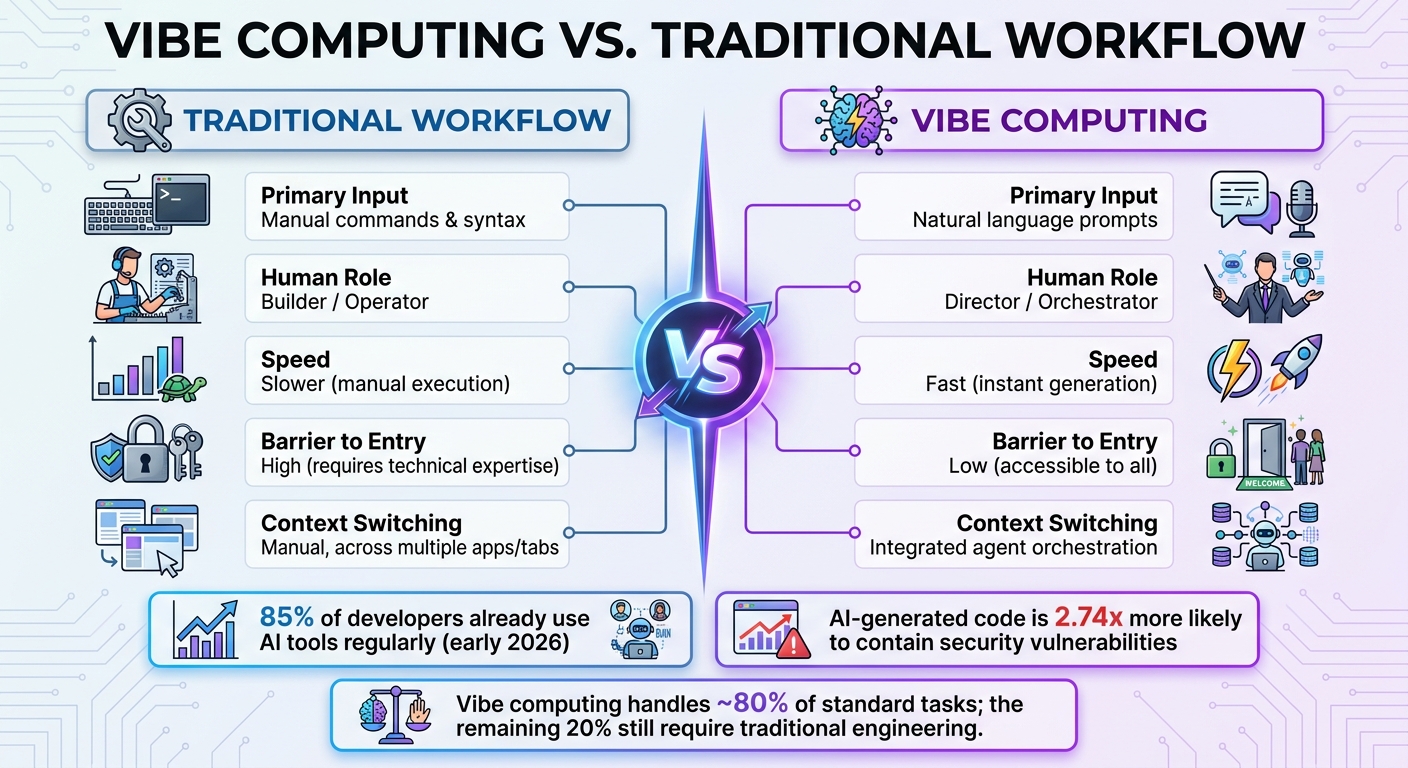
Vibe computing can dramatically speed up how tasks are completed. Processes that once required days of manual effort can now be accomplished in seconds - or, at most, a few hours. By early 2026, about 85% of developers were already using AI tools regularly. Platforms leveraging vibe computing have also seen rapid commercial success; for example, Lovable hit $10M in Annual Recurring Revenue just months after its 2025 launch.
Another major advantage is accessibility. Vibe computing makes it possible for non-technical professionals - like product managers, designers, and entrepreneurs - to build functional tools and automate workflows without relying on engineering teams.
| Dimension | Traditional Workflow | Vibe Computing |
|---|---|---|
| Primary Input | Manual commands, syntax | Natural language prompts |
| Human Role | Builder/Operator | Director/Orchestrator |
| Speed | Slower (manual execution) | Fast (instant generation) |
| Barrier to Entry | High (technical expertise) | Low (accessible to all) |
| Context Switching | Manual, across multiple apps/tabs | Integrated agent orchestration |
While these benefits are impressive, they come with notable challenges.
Limitations and Risks
Vibe computing isn't without its downsides. Security is a significant concern. AI-generated code is 2.74 times more likely to have vulnerabilities, with nearly half of it containing issues like SQL injection, missing authentication on API routes, or hardcoded secrets. These problems often go unnoticed without thorough manual review.
Another challenge is structural debt. When AI generates code, it lacks clear authorship. Since the AI doesn't maintain persistent memory and the person directing it might not fully understand the code, it becomes difficult to troubleshoot or fix issues when something breaks.
"Technical debt compounds exponentially when you don't understand your code. Every 'vibed' fix becomes a black box, and those black boxes multiply." — Namanyay Goel, Developer
Over-relying on AI can also erode critical skills like debugging and system architecture. This makes it harder for teams to step in and address problems when the AI produces errors.
Is Vibe Computing Right for You?
Weighing the benefits and risks is essential to decide if vibe computing suits your needs. It's particularly effective for about 80% of standard tasks - things like forms, tables, CRUD operations, and navigation. However, the remaining 20% of tasks, which involve custom, complex, or performance-critical logic, still require traditional engineering.
Before adopting vibe computing, consider these questions: Can your team verify every package the AI installs? Do you have manual reviews in place for critical security routes? Is there a plan for escalating issues when they arise?
| Project Type | Use Vibe Computing? | Key Guardrail |
|---|---|---|
| Internal admin tool | Yes | Basic functional testing |
| Public MVP or SaaS product | Yes | Manual security audit + authentication check |
| Healthcare or fintech app | Hybrid only | Professional security review; manual core logic |
| Performance-critical system | No | Traditional engineering required |
For teams that set clear boundaries, rigorously review AI output, and use version control, vibe computing can significantly boost productivity. But for those expecting a fully autonomous solution without oversight, the risks can outweigh the benefits.
Conclusion
Vibe computing is reshaping how we interact with technology. By leveraging natural language and contextual understanding, it simplifies complex workflows. Instead of manually executing tasks, you simply articulate your goal, and the AI takes care of the rest - turning you into a strategist who sets the vision while the AI handles the details.
By early 2026, 46% of new GitHub code was AI-generated, and the AI coding tools market, valued at $4.7 billion, is expected to grow to $12.3 billion by 2027. These numbers underscore both the immense potential of vibe computing and the importance of maintaining proper oversight.
That said, AI-generated output still requires human review, especially for tasks involving sensitive data or security concerns. The most successful teams treat vibe computing as a tool that amplifies their abilities rather than a replacement for human expertise.
"Vibe coding doesn't replace the need to understand software. It replaces the need to type it all yourself." — Effloow Editorial
As of 2026, success in this space depends heavily on having strong product judgment, refined taste, and the ability to craft clear, concise specifications. When paired with thoughtful oversight, vibe computing has the potential to boost productivity across industries by turning clear intent into actionable results.